


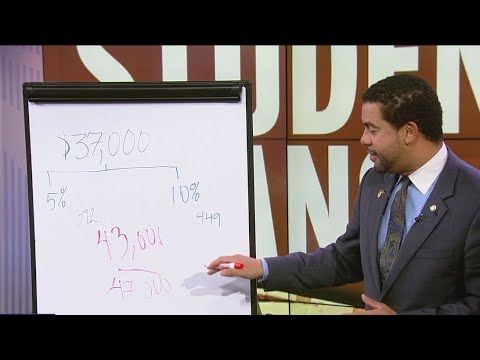
Question: What is the interest rate on student loans?
Answer: I know that many students would love to have the answer to this question. However, there is no real way to know exactly what the current interest rate on student loans is since these loans are private institutions. If you’re looking for the best way to pay off school loans faster, then check out our guide below!
What Is The Interest Rate On Student Loans?
Interest rates on student loans have recently been at historic lows. But what does this mean? Should students still borrow money to pay for college if they’re going to graduate with thousands of dollars in debt? To help answer these questions, we put together a list of everything you need to know about interest rates on student loans.
Student Loan Interest Rates Are Dropping
The biggest drop in interest rates began earlier this year when President Donald Trump signed the Tax Cuts and Jobs Act, which cut taxes for many Americans, including those who take out student loans. Under the new tax law, many borrowers may qualify for lower monthly payments and even forgiveness programs. Borrowers generally receive two types of relief under the law: 1) tax credits 2) loan repayment.
Tax Credits vs. Loan Repayment
Under the old tax code, a borrower was only eligible to claim tax credits on their federal student loans. A borrower could make no claims on state-issued loans. Now, under the new tax law, borrowers can claim both sets of credits. In addition to the tax credit, borrowers now have access to income-based repayment plans, which allow them to cap their monthly payment based on how much they earn each month. These plans can be either subsidized or unsubsidized (meaning the government pays the bill).
Borrower Income Levels
Loan repayment is capped at 15 percent of your discretionary income — meaning the amount left over after paying bills, rent, food, etc. You can find out how much your discretionary income is by filing a “1040EZ” form. If your adjusted gross income is less than $25,000, then your discretionary income will fall below the maximum for any plan; however, if your AGI exceeds $30,000, then you should have no trouble qualifying for any plan.
Federal Loans
There are three different types of Federal student loans: Direct Subsidized, Direct Unsubsidized, and Federal Family Education Loan (FFEL). With a Direct Subsidized loan, the interest rate is fixed at 6.8 percent while with a Direct Unsubsidized loan, the rate starts at 8.25 percent. FFEL loans are based on your income. Starting in 2014, borrowers had the option to select between a 5.31 percent Fixed APR and a 7.9 percent Variable APR.
State Loans
For borrowers enrolled in schools outside of the US, the interest rate may be higher. As of June 2017, Pennsylvania school students were still subject to a variable rate of 4.75 percent on Stafford loans. Rhode Island students continue to have to pay a 9.25 percent variable rate as well.
If you’re considering borrowing money to pay for your education, talk to your lender first to determine whether you qualify for a lower interest rate.
What Is The Interest Rate On Student Loans?
What is the interest rate on student loans?
The interest rate on federal Stafford loans ranges from 4.29% – 6.31%. Federal Perkins loans have an interest rate of 5.66% – 9.51%. If you are taking out private student loan, make sure you know what the rates are. You may find that they are higher than the government’s rates.
How much money does the average college graduate leave with after paying for their tuition and fees?
According to a report put together by the Institute for College Access & Success (TICAS), the median amount graduates finish school with in terms of debt is $30,400. That number includes both public and private university students. Graduates who attended for-profit institutions ended up having the highest amount of debt at $47,900. Those attending non-profit schools were second at $34,200. Public school grads had the smallest amount of debt at just over $13,000. Private school grads finished school with a whopping $60,500 in debts.
How long do you need to pay off student loan debt?
If you’re using a federal loan, you’ll need to repay those loans until either you die or they’re paid off. According to a 2014 study by New York University’s Center for Tax Policy and Administration, the average repayment period for a federal student loan was 25 years. The longer you take to pay back your loans, the lower your monthly payments will be. However, if you’ve graduated already and you don’t plan on working for the next 25 years, then you should consider refinancing your loans or using them as a capital investment instead.
What Is The Interest Rate On Student Loans?
How To Pay Off Your Debt In Just Four Years?
Description: Student loans have become a major problem among students today. The interest rates on these loans are extremely high compared to others. But if you pay them off early, they could save you some money. You’ll find out how to do just that right here.
What Is The Interest Rate On Student Loans?
Interest rate on student loans refers to the interest rates charged by private lenders for their outstanding loan balances. In many cases, these rates may be lower than those paid by government-sponsored programs such as federal education loans. However, private loans tend to have higher fees and require monthly payments over a longer period of time. As a result, students often choose to use federal loans instead.
The interest rate on student loans is determined by the following factors:
Federal Reserve policy
State’s level of oversight
Number of borrowers
Loan type
Most states do not regulate student loans; therefore, they remain under federal authority. The U.S. central bank sets monetary policy and influences short-term interest rates. These rates affect all types of debt instruments including mortgage, auto, credit cards, commercial paper, and student loans. A rise in short-term interest rates tends to push up long-term rates.
Federal law currently limits the amount of money that can be borrowed per year, although some schools and colleges allow unlimited borrowing. There are three different loan types: subsidized, unsubsidized, and direct lending.
Subsidized loans are issued at low interest rates and backed by the federal government. Unsubsidized loans are subject to market forces and carry variable rates and fees. Direct lending is offered exclusively through banks and makes no financial aid guarantees.
►HEY, we’ve got more valuable information here: ►CLICK HERE LOANS FOR STUDENTS◄
►Cloud of related items ▼
bloque1x

Related Links ▼
- Studentaid.gov/understand-aid/types/loans
- Salliemae.com/student-loans/
- Discover.com/student-loans/
- Nerdwallet.com/best/loans/student-loans/private-student-loans
- Money.usnews.com/loans/personal-loans/personal-loans-for-students
- Credible.com/blog/student-loans/personal-loans-for-students/
- Govloans.gov/categories/education-loans/
- Forbes.com/advisor/student-loans/best-private-student-loans/
- Navyfederal.org/loans-cards/student-loans.html
- Wellsfargo.com/goals-going-to-college/loan-options/
- Whitehouse.gov/briefing-room/statements-releases/2022/08/24/fact-sheet-president-biden-announces-student-loan-relief-for-borrowers-who-need-it-most/
- Ed.gov/category/keyword/federal-student-loans
- Myfedloan.org/
- Navient.com/
- Usa.gov/student-loans
 English
 Afrikaans
 Albanian
 Amharic
 Arabic
 Armenian
 Azerbaijani
 Basque
 Belarusian
 Bengali
 Bosnian
 Bulgarian
 Catalan
 Cebuano
 Chichewa
 Chinese (Simplified)
 Chinese (Traditional)
 Corsican
 Croatian
 Czech
Czech Danish
 Dutch
Dutch Esperanto
 Estonian
 Filipino
 Finnish
 French
 Frisian
 Galician
 Georgian
 German
 Greek
Greek Gujarati
 Haitian Creole
 Hausa
Hausa Hawaiian
 Hebrew
 Hindi
Hindi Hmong
Hmong Hungarian
 Icelandic
 Igbo
Igbo Indonesian
 Irish
Irish Italian
 Japanese
 Javanese
 Kannada
 Kazakh
 Khmer
Khmer Korean
 Kurdish (Kurmanji)
 Kyrgyz
 Lao
Lao Latin
Latin Latvian
 Lithuanian
 Luxembourgish
 Macedonian
 Malagasy
 Malay
Malay Malayalam
 Maltese
 Maori
Maori Marathi
 Mongolian
 Myanmar (Burmese)
 Nepali
 Norwegian
 Pashto
 Persian
 Polish
 Portuguese
 Punjabi
 Romanian
 Russian
 Samoan
 Scottish Gaelic
 Serbian
 Sesotho
 Shona
Shona Sindhi
 Sinhala
 Slovak
 Slovenian
 Somali
 Spanish
 Sudanese
 Swahili
 Swedish
 Tajik
Tajik Tamil
Tamil Telugu
 Thai
Thai Turkish
 Ukrainian
 Urdu
Urdu Uzbek
Uzbek Vietnamese
 Welsh
Welsh Xhosa
Xhosa Yiddish
 Yoruba
 Zulu
Zulu